

Forest Residues: A great potential for energy generation
News17 de June de 2026
Generation of energy through forest residues, an alternative to fossil fuels and an environmentally friendly solution.
The generation of energy through various types of biomass is a highly discussed topic today and has great relevance because it is a renewable fuel, considering the perspectives of the scarcity of global reserves of fossil fuels and society's demands for environmentally friendly solutions.
Among the types of biomass, forest biomass is the most commonly used for this purpose. It stands out for having three distinct origins: the material from forest harvesting, the residues generated during wood processing, and the wood from energy forests.
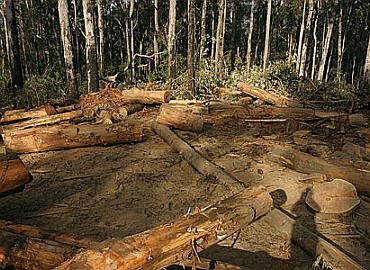
The residues considered from forest harvesting are those residues that are discarded, such as leaves, branches, bark, and parts of wood that are not utilized, like the tips and stumps that remain after cutting. In forests destined for charcoal production, it is uncommon to peel the wood, as the bark is also used as raw material; however, it is common for the bark to detach from the trunk and become a residue lost during wood processing.
In Brazil, the residues generated by wood harvesting are abandoned in the field, where their nutrients are recycled; however, it is necessary to highlight the potential of forest residue for thermal and electrical energy generation, which can be obtained through direct combustion or incineration, as well as the production of pellets and briquettes for future combustion, showing that the residue can become raw material for energy production.
A partnership between the Federal University of Viçosa, in the Wood Panels and Energy Laboratory (LAPEM), with ArcelorMittalBioFlorestas and CEMIG, is conducting a study to evaluate the potential of utilizing biomass residues and their combustion for electrical energy generation. This study evaluated a eucalyptus plantation (Eucalyptus urophyllae Eucalyptus Grandis) planted in the municipality of Martinho Campos - MG.
The study determined that leaves, branches, and tree tops represent about 5% of the estimated biomass per hectare, while the potential biomass for combustion represents approximately 90%. The study also indicated that about 25% of the bark is lost during movement, a process that involves cutting, felling, extraction, stacking, and drying of the wood.
This study shows that approximately 10% of the tree is left behind in the forest because it is not useful for the timber market; however, considering the amount of waste per hectare, it is possible to see the opportunity for a new cheap and profitable business in transforming these residues into biomass, whether in the production of chips, pellets, or briquettes.
Want to know more?
Check out some equipment that can be used in the transformation of residues into biomass: