

Municipalities must act: sorting and reducing waste volume is no longer optional
RECYCLING15 de October de 2026
Solid waste management has become one of the biggest challenges for Brazilian city governments. The National Solid Waste Policy (Law 12,305/2010) already required environmentally sound disposal. The New Legal Framework for Sanitation (Law 14,026/2020) set deadlines for closing open dumps, and those deadlines have already expired for most municipalities. Those that have not yet complied face penalties, lawsuits from the Public Prosecutor's Office, and loss of access to federal funding. Meanwhile, landfills are filling up faster and faster, and the cost of transport and disposal weighs more heavily on the budget every year.
A large part of the problem comes from bulky waste: construction and demolition debris, pruned branches and tree trunks, discarded furniture, wood, and end-of-life tires. These materials take up a lot of space, and much of that space is air. Trucks travel with a "full" load that carries little weight, and at the landfill these materials consume cells that should last for years. Many of them, however, have value once shredded and sorted. Debris becomes recycled aggregate for rural road bases, pruning waste becomes mulch or compost feedstock, wood becomes biomass, and metal returns to industry.
That is why sorting and reducing volume at the source is no longer just good practice but an economic and legal necessity. A municipality that separates its waste streams and reduces volume before transport spends less on freight, extends the life of its landfill, generates reusable material, and can show oversight bodies that it complies with the law.
Where the Compaktor 300 comes in
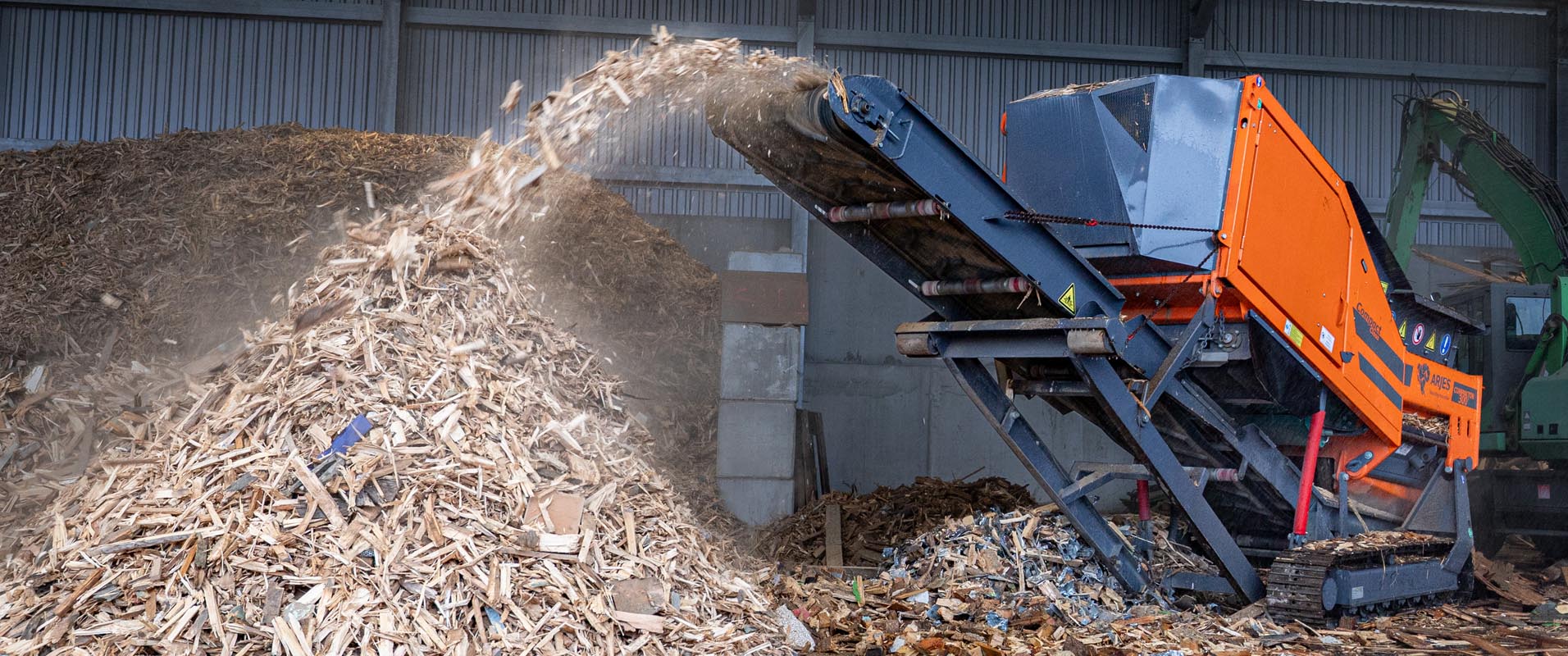
The ARJES Compaktor 300 is a solution designed precisely for this pre-shredding stage. It is a compact, mobile two-shaft shredder developed for the economical pre-shredding of a wide range of material streams and for volume reduction of construction and commercial waste. It processes mixed construction and demolition waste, biomass, waste wood, rubber, and end-of-life tires.
Mobility is the main advantage for a city government. The machine comes standard with a crawler track system and, thanks to its compact dimensions, adapts well to changing sites, confined spaces, or as an addition to existing processing plants. In practice, the machine can go to the drop-off point, the pruning yard, the fill site, or a public demolition site, instead of the municipality hauling all the bulky material to it. This cuts truck trips, fuel, and fleet wear.
Its capacity also fits the reality of small and medium-sized municipalities. Listings for the model indicate 80 to 100 tonnes per hour for construction waste, 6 to 12 t/h for rubber and tires, and 5 to 15 t/h for waste wood. Some configurations also include a water sprinkler system, which helps control dust, and an overbelt magnet that removes ferrous metals from the shredded material. This magnet performs, in the same operation, part of the sorting the law requires, and the recovered metal can be sold.
Operation was also designed to be simple. The machine has a quick shaft change system that reduces downtime and maintenance, and an SCU control system with predefined programs. Adjustable side combs make it possible to regulate throughput and final particle size. This way, the same machine can produce, for example, a finer aggregate for paving rural roads or a coarser material to reduce volume before landfilling. The Volvo Penta engine meets EU Stage V / EPA Tier IV emission standards in the European and American versions. For environmentally sensitive locations or sites near urban areas, there is the stationary Compaktor 300 e-pu version, with a 160 kW electric motor and low-noise, low-emission operation.
The benefit for the municipality
Investing in shredding and sorting changes the logic of waste management. What used to be only a cost becomes, in part, raw material: recycled aggregate for public works, biomass, compost, and scrap metal. The landfill lasts longer, the fleet drives less, and the municipality gains concrete evidence that it complies with the National Solid Waste Policy and the Sanitation Framework. For inter-municipal consortia, the machine's mobility allows several municipalities to be served by a single unit, sharing the investment.
It is worth noting that the Compaktor 300 is a shredder for bulky and construction waste and does not replace selective collection or the treatment of organic household waste. It works best as part of an integrated municipal management plan, alongside drop-off points, selective collection, and composting. Within such a plan, however, it tackles precisely the fraction that takes up the most space and drives up operating costs the most.
The choice today is not between acting and waiting. Legislation, costs, and lack of space have already decided that action is needed. It is up to each municipality to choose to act efficiently.
+55 47 3300.1220